From harmless snoring to sleep apnoea
Snoring happens when the upper airway narrows partly during sleep and the soft tissue starts to vibrate. This is often bothersome for your partner, but otherwise harmless.
With obstructive sleep apnoea syndrome (OSAS) the airway repeatedly closes completely for a short moment. You briefly stop breathing each time, wake very briefly without noticing, and never reach deep sleep. As a result you feel tired and poorly rested during the day. Left untreated, sleep apnoea can in time also strain your heart and blood pressure.
Do you recognise this?
Often it is your partner and those around you who notice the first signs. These complaints frequently occur together in sleep apnoea.
With audible breathing pauses and gasping for air.
Nodding off in front of the TV, while reading or behind the wheel.
Morning headaches and a dry mouth or throat.
Irritability, forgetfulness or low mood.
Restless nights and getting up several times.
Sleep apnoea and high blood pressure are often linked.
Careful diagnostics, at home in your own bed
We first map out how severe the complaints are and whether further assessment is needed. This lets us choose a treatment that fits your situation.
Conversation & ENT examination
We discuss your symptoms and sleep pattern and use a videoscope to look for a visible cause in the nose and throat.
Sleep measurement at home
With the WatchPAT you measure your breathing, oxygen and sleep at home for one night. Comfortable, in your own bed.
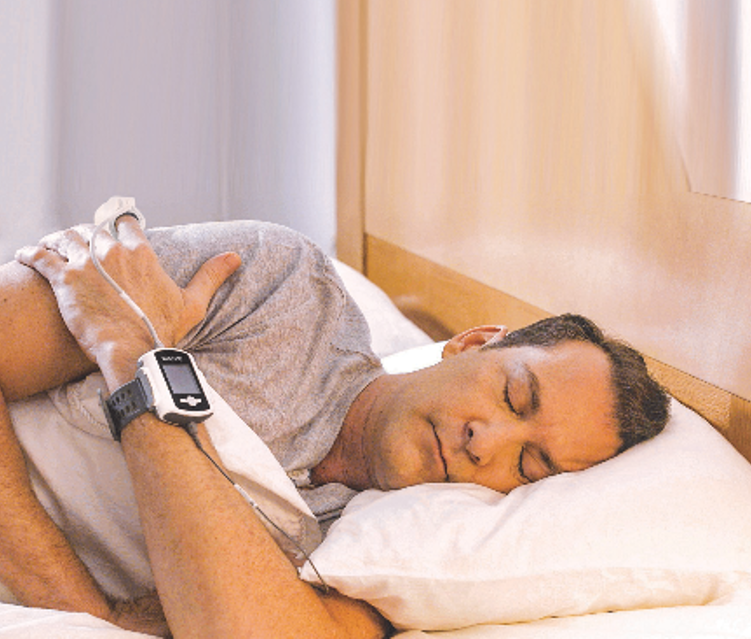
You take the device home directly and fit it yourself: a sleeve on the finger, a sticker electrode on the chest and the measuring watch on the wrist. After one night you return the device to us; the data is read out and discussed in the multidisciplinary team (ENT specialist and pulmonologist-somnologist/sleep specialist), after which the ENT specialist discusses the result with you.
For more information about the WatchPAT, visit www.itamar-medical.com/patients. If anything is unclear, feel free to contact us for a full explanation.
General lifestyle tips
The treatment that suits you
There is no standard solution. Depending on the findings, we discuss one of these options together — sometimes a combination.
Positional therapy
Snoring and apnoea are often position-dependent. For complaints that mainly occur lying on your back, a snoring belt/position trainer can help: a small device worn on a band around the chest before sleep. Its built-in position sensor gives a gentle vibration when you lie on your back, prompting you to turn onto your side — training you to sleep on your side without disrupting your natural sleep pattern. We use the Philips NightBalance for this, supplied via Vivisol Home Care Services (vivisol.nl).
Mandibular Advancement Device (MAD)
A custom-made oral appliance that holds your lower jaw slightly forward at night, so the throat stays open. This is fitted by an NVTS-accredited dentist. We collaborate with several practices in the region.
CPAP
A CPAP (Continuous Positive Airway Pressure) device uses a tube and a custom-fitted mask over the nose (and sometimes the mouth) to blow air into your throat at slight overpressure. This pressure keeps the throat open, reducing breathing pauses and the complaints they cause — the most effective treatment for severe apnoea. We work with Vivisol Home Care Services; more information is available at pap.vivisol.nl.
Surgical treatment
If the airway narrows, a procedure on the nose, soft palate, tongue, jaw or neck may be possible. We discuss whether you're a candidate.
Inspire (hypoglossal nerve stimulation)
For a select group of patients: a small implant that activates the tongue nerve to keep the airway open. Only carried out in specialised centres. We discuss whether you're a candidate.
How your care unfolds
One dedicated ENT specialist, together with a sleep specialist
You are supported personally and keep the same doctor throughout your care.
BIG 19066557501
BIG 59052036201
Frequently asked questions
Ready to have your sleep assessed?
For an appointment at De KNO Praktijk Nijmegen you need a referral from your GP. Discuss your symptoms with your GP; they assess whether a referral for a sleep study is needed. Usually this arrives with us digitally; we then contact you ourselves to schedule an appointment.